Science becomes truly exciting when children can see it working in the real world.
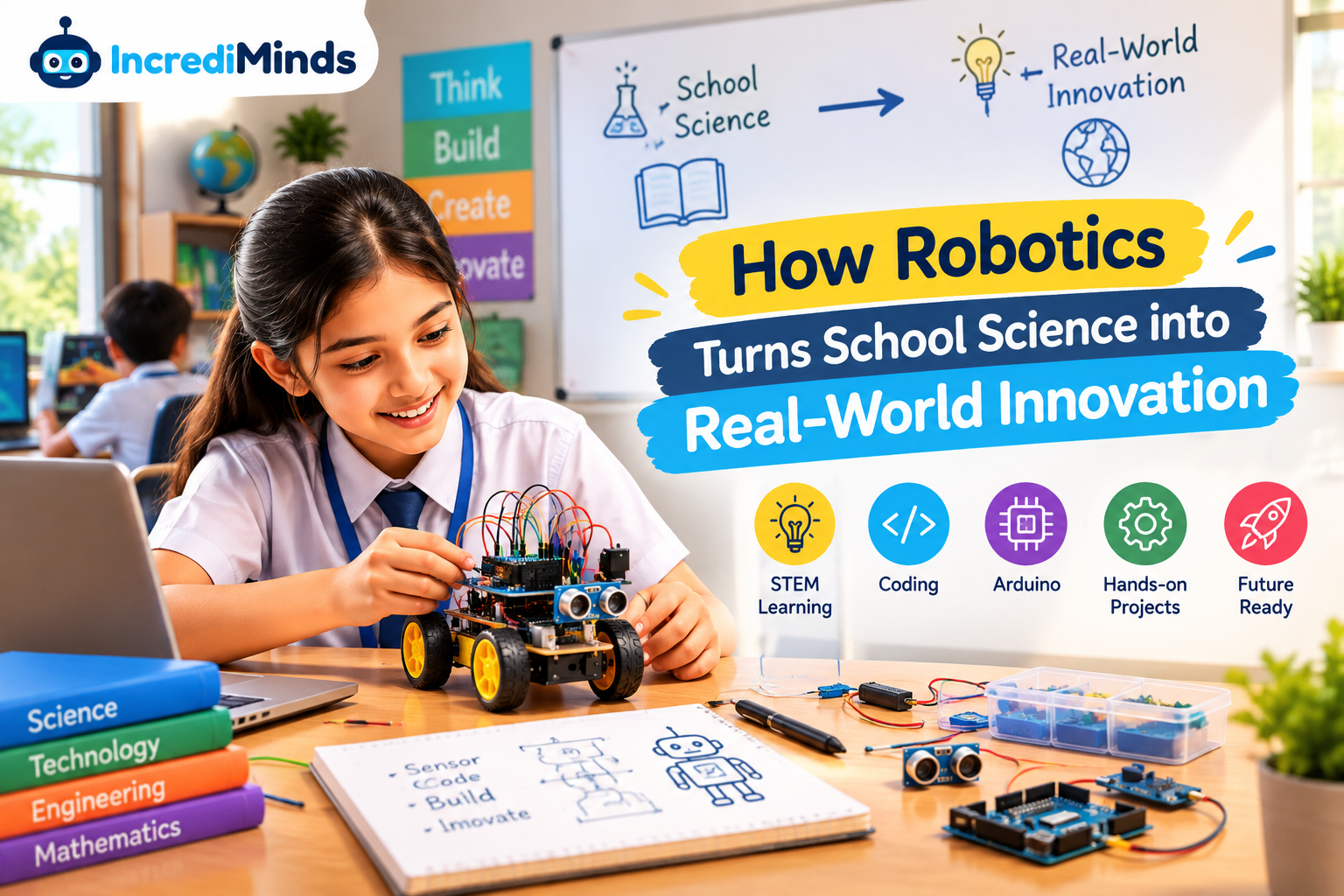
In school, students learn about electricity, motion, force, energy, measurement, sensors, and other scientific concepts through textbooks and experiments. But when these concepts are combined with robotics and coding, children can turn classroom knowledge into working inventions.
This is where robotics education for kids can make a powerful difference.
At IncrediMinds Robotics, we believe that children shouldn't just learn science—they should get opportunities to build, experiment, solve problems, and innovate.
Imagine a student learning about distance measurement in science class.
Instead of only reading about it, the student connects an ultrasonic sensor to an Arduino and creates a system that measures the distance to an object.
Suddenly, an abstract concept becomes a working technology.
This is the power of combining school science with robotics.
Children can use:
These simple components can become the foundation for much bigger innovations.
Robotics brings together several areas of STEM education:
Science + Technology + Engineering + Mathematics = Innovation
A robotics project may require a child to understand scientific principles, calculate measurements, design a structure, write a program, test the result, and modify the design.
Instead of learning each subject separately, students begin to understand how different concepts work together.
That is why STEM robotics for kids can be such an effective learning experience.
One of the most important lessons robotics can teach children is that technology should solve problems.
Consider some simple examples:
Students can use sensors and Arduino to monitor soil conditions and create a basic smart farming system.
They learn about soil, moisture, agriculture, sensors, automation, and programming—all within one project.
An ultrasonic sensor can detect when a hand approaches a trashbin, while a servo motor automatically opens the lid.
A simple classroom robotics project becomes an introduction to sensors, automation, electronics, and programming.
Children can use ultrasonic sensors to measure the distance between a vehicle and an obstacle.
Add LEDs and a buzzer, and students can create a smart parking assistant.
This introduces them to technologies used in real-world parking and vehicle safety systems.
A rain sensor can be connected to an Arduino to detect water and trigger an alert or automated action.
Students can explore how sensors and automation can be used to respond to environmental conditions.
These projects demonstrate an important idea:
Innovation often begins by asking, “Can technology solve this problem?”
A robot rarely works perfectly on the first attempt.
Maybe the motor isn't moving correctly.
Perhaps the sensor is giving unexpected readings.
Maybe the code has an error.
Instead of giving up, students learn to:
Observe → Identify → Test → Fix → Improve
This process develops logical thinking, computational thinking, debugging skills, and problem-solving abilities.
These skills are valuable not only in robotics but also in mathematics, science, coding, engineering, and everyday life.
A robot without instructions cannot do much.
Coding gives students the ability to tell their machines what to do.
Through platforms such as Arduino, Scratch, and Tinkercad, children can gradually learn programming concepts including:
The exciting part is that students immediately see the result of their code.
When a child writes a program and watches a motor move or an LED turn on, coding becomes tangible.
Hands-on DIY electronics projects can encourage children to move beyond simply consuming technology.
Instead of asking:
“What can this technology do?”
they begin asking:
“What can I create with it?”
That change in mindset is at the heart of innovation.
A simple Arduino project can become a prototype. A prototype can become a science exhibition project. A science project can eventually inspire a much bigger idea.
Robotics can also make school science exhibitions more engaging.
Students can create interactive projects such as:
These projects allow students to demonstrate both scientific understanding and practical application.
More importantly, students learn how to explain their ideas, demonstrate their prototypes, work as a team, and respond to questions.
These are essential skills for future innovators.
The world is increasingly shaped by Artificial Intelligence, robotics, automation, IoT, electronics, and smart technologies.
Children don't necessarily need to become engineers or programmers.
But understanding how technology works—and knowing how to use it creatively—can give them an important advantage.
Early exposure to robotics and STEM education can help children develop curiosity, confidence, creativity, collaboration, and problem-solving skills.
At IncrediMinds Robotics, we aim to bridge the gap between what children learn in school and what they can create in the real world.
Our hands-on learning approach brings together:
Robotics • Arduino • Coding • LEGO Robotics • Electronics • Tinkercad • AI • IoT • Automation • STEM Education • Computational Thinking
Students don't just watch demonstrations.
They build projects, write code, test their ideas, troubleshoot problems, and improve their designs.
Because we believe that the best way to learn technology is to experience it.
The journey can start with something as simple as an LED.
Then comes a sensor.
Then a motor.
Then some code.
Eventually, the child starts combining everything to solve a real-world problem.
That is how school science can become innovation.
And that is exactly what robotics education should inspire:
Curious children who don't just learn about the future—they start building it.