
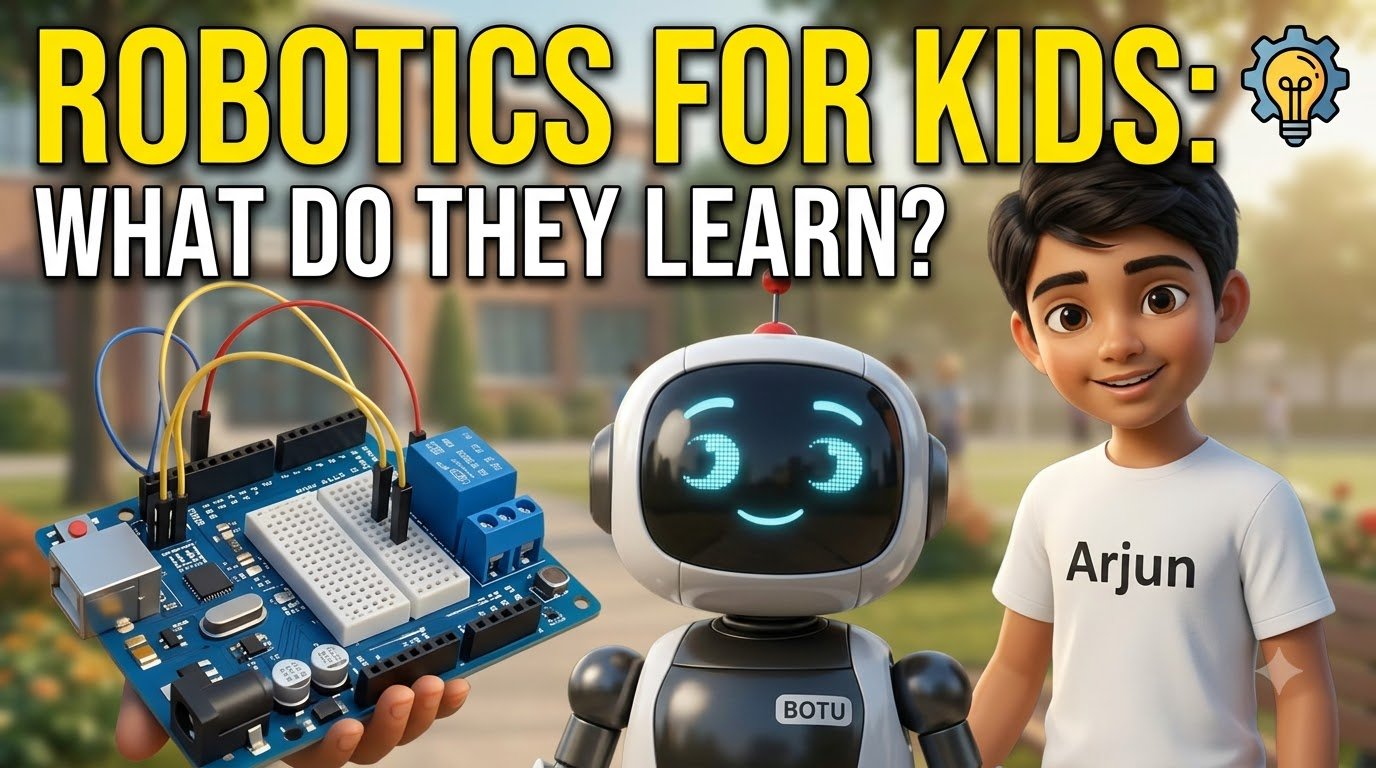
Robotics is no longer just a subject for engineers and technology enthusiasts. Today, robotics classes for kids are helping students develop practical skills while making learning fun, creative, and hands-on.
But what do children actually learn in a robotics class?
Children learn the basics of coding and programming by controlling robots and electronic components. Platforms such as Arduino, Scratch, and Tinkercad make programming easier and more engaging for beginners.
Instead of simply learning code from a textbook, kids can immediately see what their code does in the real world.
Through Arduino projects for kids, students learn how sensors, LEDs, buzzers, motors, and servo motors work. They understand concepts such as inputs, outputs, circuits, and automation by building working projects.
From a smart dustbin and automatic parking system to a radar and smart home, children learn by creating.
Robotics teaches children to break a big problem into smaller steps. They learn to think logically, identify mistakes, test solutions, and improve their designs.
These problem-solving and computational thinking skills are useful far beyond robotics.
The best robotics classes encourage children to design, build, experiment, and innovate. Kids can turn their ideas into working STEM projects and DIY electronics projects, giving them confidence to become creators rather than just technology users.
Robotics education can also prepare students for robotics competitions, science exhibitions, STEM challenges, and innovation programs. More importantly, it introduces children to future-focused fields such as engineering, artificial intelligence, automation, IoT, and embedded systems.
At IncrediMinds Robotics, we believe children learn technology best when they build it themselves. Our hands-on approach combines Robotics, Arduino, Coding, AI, STEM Education, Electronics, Tinkercad, and Computational Thinking to make technology exciting and accessible for students.
The goal isn't simply to teach children how to build a robot.
It is to teach them how to think, create, solve problems, and innovate.