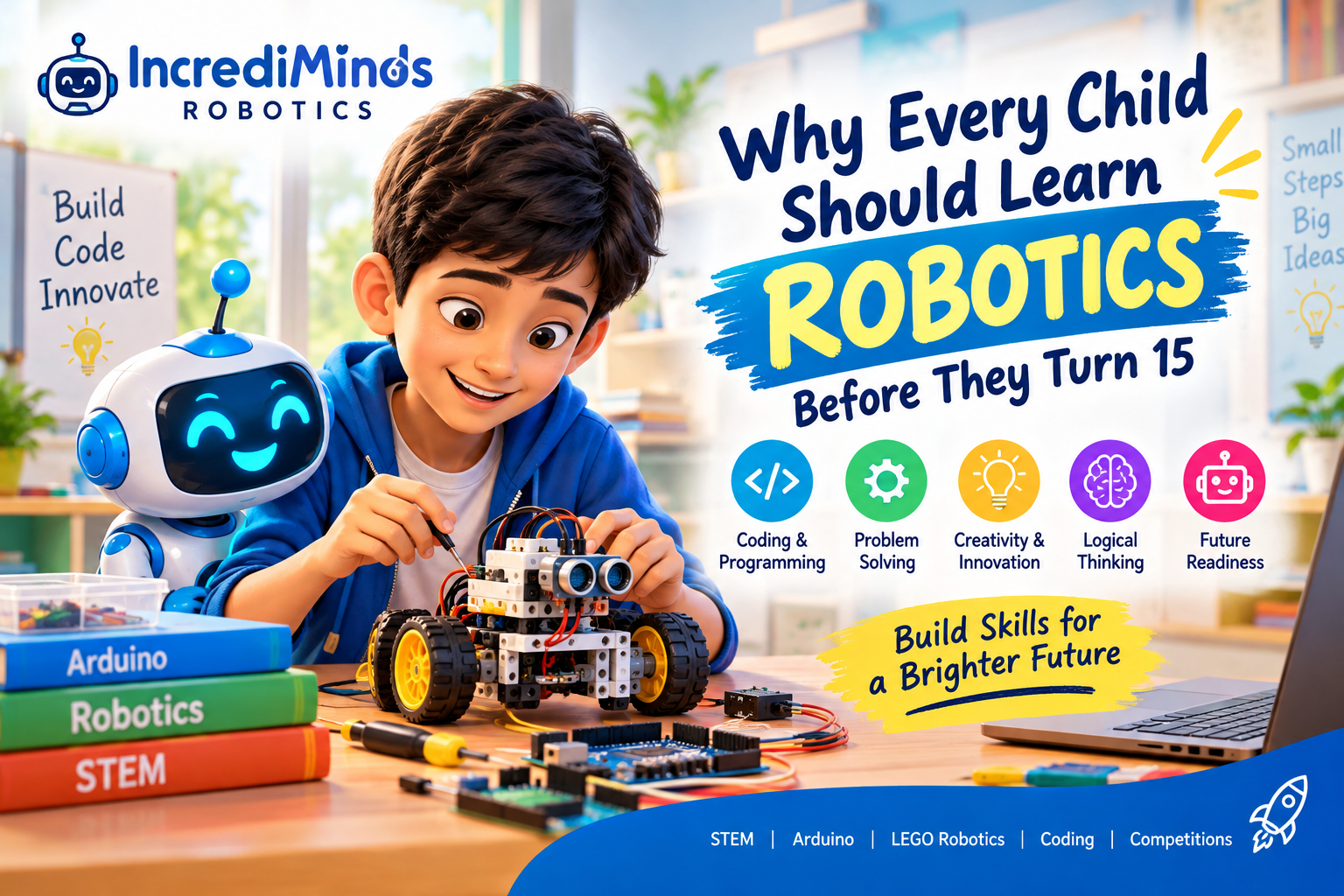
Imagine a 12-year-old child looking at a pile of wires, sensors, motors and a tiny Arduino board.
To an adult, it might look like a collection of electronic components.
To a child, it can become a smart door, a robot, a flood alarm, an automatic parking system—or an idea nobody has built before.
That is the magic of robotics education.
At IncrediMinds Robotics, we believe robotics isn't simply about building robots. It is about teaching children to think, experiment, solve problems, make mistakes, and turn ideas into something that actually works.
And the earlier children experience this process, the more naturally they begin to think like creators rather than just consumers of technology.
When parents hear robotics classes for kids, they often imagine children assembling LEGO robots.
That's certainly part of it—but robotics goes much deeper.
A robotics project can bring together:
For example, a child might build an automatic door using an Arduino, ultrasonic sensor and servo motor.
Suddenly, concepts that seemed abstract in a textbook become real.
The child sees:
Sensor → Decision → Motor → Action
That's STEM education coming alive.
Children between roughly 8 and 15 are naturally curious.
They ask:
"Why does this happen?"
"What if I change this?"
"Can I make it automatic?"
"What happens if I connect this sensor?"
Robotics gives those questions somewhere to go.
Instead of simply giving children answers, hands-on robotics encourages them to investigate the answers themselves.
A child who learns to experiment early develops an important mindset:
"If I don't know how it works, I can figure it out."
That mindset can be more valuable than memorizing another chapter from a textbook.
Coding can be difficult for beginners because programming is often invisible.
You write code—and nothing physical happens.
Robotics changes that.
A child writes a program and suddenly:
Code becomes action.
Platforms such as Arduino, LEGO robotics and Scratch programming allow children to gradually understand programming concepts through experimentation.
Instead of asking:
"Why do I need to learn loops?"
they discover:
"Oh! The robot needs a loop so it keeps checking the sensor!"
That's a powerful learning moment.
Robotics introduces children to something fascinating:
Machines can sense their surroundings.
An ultrasonic sensor can detect distance.
A soil-moisture sensor can detect moisture levels.
A rain sensor can detect water.
A touch sensor can detect physical interaction.
An LDR can detect changes in light.
An MQ-series gas sensor can detect changes in certain gases.
Children begin to understand that technology isn't "magic."
It follows a process:
Sense → Process → Respond
This is the foundation of countless real-world technologies, from smart homes and automation systems to industrial robots and autonomous vehicles.
Here's something every robotics mentor eventually discovers:
The best learning often happens when the robot doesn't work.
The motor doesn't move.
The sensor gives the wrong reading.
The wire is connected incorrectly.
The code has an error.
The robot turns left instead of right.
And the child asks:
"Why?"
That one question starts the engineering process.
They inspect.
They test.
They change something.
They try again.
And eventually—
It works.
That experience teaches debugging, patience, resilience and problem-solving in a way that a worksheet rarely can.
Computational thinking isn't just about computers.
It is about learning how to break a large problem into smaller, manageable steps.
Suppose a student wants to build an automatic parking assistant.
Instead of thinking:
"I need to make a smart parking system."
they learn to break it down:
This ability to decompose problems and develop logical solutions is useful far beyond robotics.
Children already interact with technology every day.
They use smartphones.
They watch videos.
They play games.
They use apps.
But there's a big difference between using technology and understanding how to create it.
Robotics encourages children to move from:
"I use this."
to:
"I can build this."
Imagine the confidence a child feels when a project they designed actually responds to their actions.
That feeling can become the beginning of a lifelong interest in technology, engineering, coding and innovation.
Robotics competitions can be incredibly valuable—but not simply because children might win.
A competition forces students to experience the complete innovation cycle:
Idea → Design → Build → Program → Test → Fail → Improve → Present
They learn to work in teams.
They learn to divide responsibilities.
They learn to explain their ideas.
They learn to deal with unexpected problems.
And perhaps most importantly, they learn that failure is not the opposite of innovation—it is part of it.
Winning is wonderful.
But the skills developed while preparing for the competition can stay with a child much longer than a trophy.
One of the biggest advantages of STEM robotics education is that it doesn't stay inside one subject.
A single project can involve:
Measurements, angles, distance, speed and calculations.
Electricity, energy, motion, sensors and physical phenomena.
Algorithms, programming, logic and debugging.
Designing mechanisms, selecting components and building prototypes.
Designing the appearance and user experience of a project.
That's why robotics can become a powerful interdisciplinary learning experience.
India is rapidly developing as a technology and innovation ecosystem.
Students are growing up alongside AI, robotics, automation, drones, electric vehicles, IoT and smart technologies.
But preparing children for this future isn't about forcing every child to become an engineer.
It's about giving them the opportunity to understand technology early.
A child who experiments with Arduino projects, LEGO robotics, Scratch coding, sensors and automation develops familiarity with the building blocks of modern technology.
And perhaps that child eventually becomes an engineer, researcher, entrepreneur, designer—or something we haven't even imagined yet.
At IncrediMinds Robotics, our goal isn't simply to teach children how to follow instructions.
We want children to build, experiment and innovate.
Our hands-on approach brings together:
Robotics + Coding + Electronics + STEM + Computational Thinking + Creativity
Students can explore platforms and concepts such as:
The objective is simple:
Don't worry about starting with a complicated robot.
Start with something that produces an immediate result.
For example:
Beginner:
💡 LED + Arduino
Next:
📡 Ultrasonic Sensor + Buzzer
Then:
🚪 Automatic Door
Then:
🌱 Smart Farming System
Then:
🤖 Autonomous Robotics Project
Each project adds another layer of understanding.
And before long, children aren't just following tutorials.
They're asking:
"What can I build next?"
That's the moment learning becomes innovation.
Coding languages will change.
Robotics platforms will change.
Sensors will become smarter.
Artificial intelligence will transform industries.
But some skills will remain valuable:
Curiosity.
Problem-solving.
Creativity.
Critical thinking.
Collaboration.
The confidence to experiment.
Robotics education gives children a playground where these skills can develop naturally.
Your child doesn't need to know advanced mathematics.
They don't need to be a programming expert.
They don't need to already understand electronics.
They simply need one thing:
Give that curiosity a sensor.
Give it a motor.
Give it some code.
Give it permission to fail.
And watch what happens.
Because the child who learns to build technology today may become the person who creates tomorrow's technology.
IncrediMinds Robotics helps children explore the exciting world of robotics, Arduino, coding, STEM education, electronics, automation and engineering through hands-on projects.
Learn • Build • Innovate
👉 Interested in robotics classes for your child? Explore IncrediMinds Robotics and start their journey from curiosity to creation.