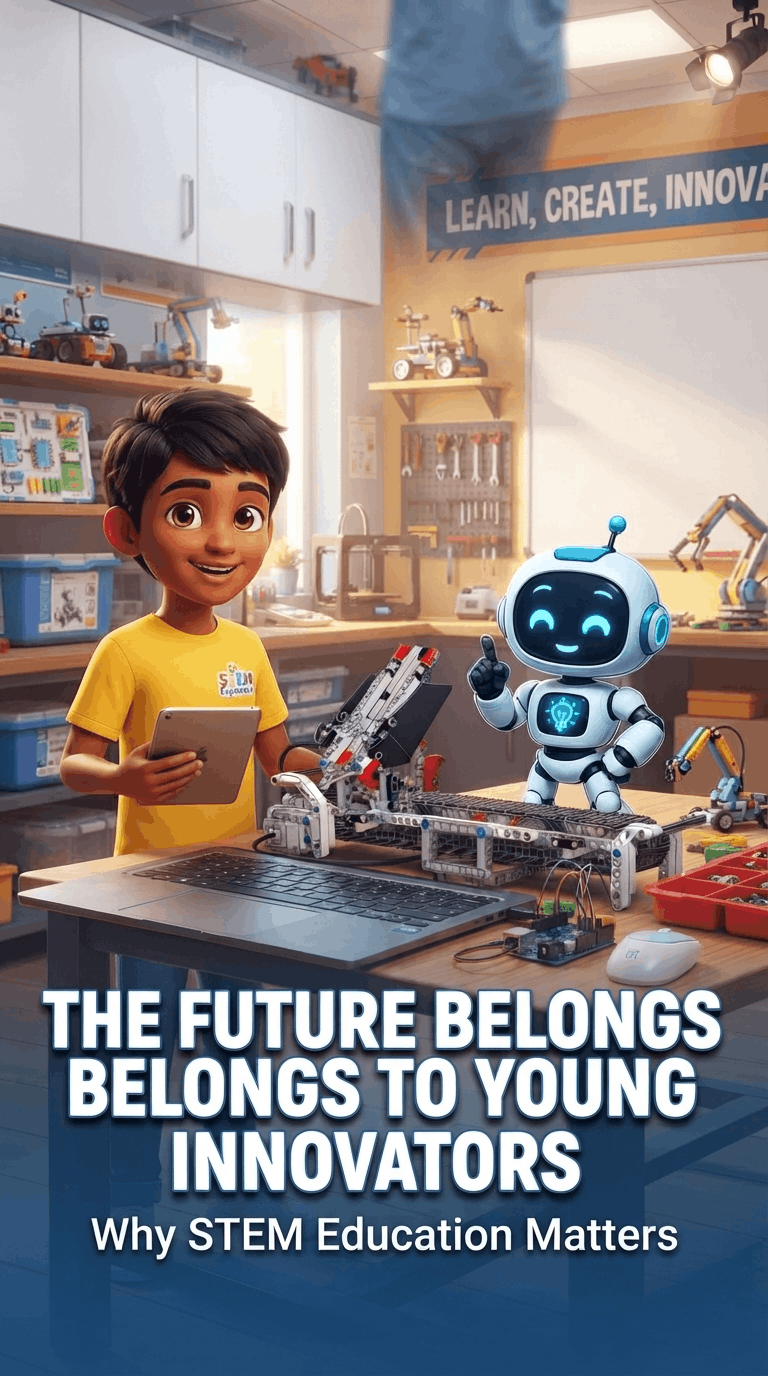
Meta Title: The Future Belongs to Young Innovators | Why STEM Education Matters
Meta Description: Discover why STEM education matters for children and how IncrediMinds Robotics helps young learners develop robotics, coding, Arduino, problem-solving, and innovation skills through hands-on learning.
Suggested URL Slug: /future-young-innovators-why-stem-education-matters
The world is changing faster than ever. Artificial intelligence, robotics, automation, smart devices, electric vehicles, IoT and advanced software are becoming part of everyday life. In this rapidly evolving world, children need more than the ability to memorize information—they need the ability to think, create, experiment and solve problems.
This is where STEM education becomes important.
STEM stands for Science, Technology, Engineering and Mathematics. Rather than treating these subjects as completely separate areas, STEM learning connects them through practical and interdisciplinary experiences. UNESCO describes STEM education as an approach that encourages critical thinking, problem-solving and innovation.
At IncrediMinds Robotics, we believe every child has the potential to become an innovator when given the right environment, tools and encouragement.
STEM education combines four important areas:
But effective STEM education is not simply about teaching children these four subjects.
It is about encouraging children to ask:
“What if?”
“Why does this happen?”
“Can I build something that solves this problem?”
That mindset is at the heart of innovation.
A child building a smart parking system using an Arduino and ultrasonic sensor is doing much more than assembling electronic components.
They are learning to:
This process develops problem-solving skills, one of the most valuable abilities children can develop for their future.
Hands-on STEM learning is particularly powerful because students can connect abstract concepts with real-world applications. Arduino's educational resources similarly emphasize programming, electronics, problem-solving and critical thinking through practical projects.
Imagine learning about distance, sensors and programming by simply reading a textbook.
Now imagine learning those same concepts by building a robot that can detect an object, measure distance and respond to its surroundings.
The second experience makes the concept tangible.
This is why robotics for kids can be such an effective STEM learning tool.
At IncrediMinds Robotics, children can explore concepts through projects involving:
The goal isn't simply to build a robot.
The goal is to understand how and why it works.
Coding is often described as a technology skill, but its benefits go far beyond programming.
When children learn coding, they learn how to break a large problem into smaller steps.
For example:
Problem: Build an automatic gate.
The child might need to think:
This develops logical thinking, sequencing, debugging and computational thinking.
From beginner-friendly block-based coding to Arduino programming, robotics gives children a reason to code because they can immediately see the result of their instructions.
Arduino's current education programs similarly include beginner block-based coding and robotics courses for young learners.
STEM is not only about equations and circuits.
It is also about creativity.
Give ten students the same problem and you may get ten completely different solutions.
One child might build an automated irrigation system.
Another might create a smart dustbin.
Someone else might design a robotic vehicle.
This freedom to experiment helps children move from being technology consumers to technology creators.
And that is an important shift.
At IncrediMinds, project-based learning encourages students to take an idea and transform it into something they can actually build, test and demonstrate.
Not every robotics project works on the first attempt.
The motor may not move.
The sensor may give unexpected readings.
The code may contain an error.
The robot may turn in the wrong direction.
And that is perfectly okay.
In fact, these moments can be some of the most valuable parts of STEM learning.
Children learn that:
Failure is not the opposite of innovation. Failure is part of innovation.
When students troubleshoot a project and finally make it work, they experience something that a textbook cannot provide—the confidence that “I can figure this out.”
The careers of tomorrow will increasingly involve technology, engineering, automation, AI, robotics, data and digital systems.
Children do not necessarily need to decide their careers at an early age. But early exposure to STEM can help them discover what interests them.
A child who enjoys building robots might become interested in:
STEM education therefore isn't just preparation for a particular job.
It is preparation for a world that is constantly changing.
UNESCO's current STEM initiatives emphasize youth innovation, inclusive STEM learning, mentorship and pathways that help young people develop skills for the future.
One of the biggest advantages of STEM education is that students develop skills that are useful even outside technical careers.
Students learn to evaluate information and make logical decisions.
Explaining a project teaches children how to communicate ideas clearly.
Robotics projects often require students to work together.
Students experiment with different designs and solutions.
Debugging teaches children not to give up when something doesn't work.
Students learn to choose components, methods and solutions.
These are future-ready skills that can benefit children throughout their academic and professional lives.
At IncrediMinds Robotics, we want children to experience technology rather than simply read about it.
Our approach focuses on hands-on STEM education, robotics projects, Arduino programming, coding, electronics, automation and creative problem-solving.
Instead of asking children to memorize how a sensor works, we can ask them to build something using that sensor.
Instead of simply explaining programming concepts, we can challenge them to write code that controls a real-world project.
Instead of telling students that engineering involves solving problems, we can give them a problem and let them design their own solution.
This project-based approach makes STEM learning more engaging and meaningful.
One of the most accessible ways for young learners to begin exploring electronics and robotics is through Arduino projects.
Arduino's educational ecosystem includes hands-on learning around programming, electronics, robotics, IoT and real-world challenges.
At IncrediMinds, Arduino can become the foundation for projects such as:
Projects like these help children understand how hardware + software + sensors + logic = a working solution.
That is the essence of engineering.
Traditional learning often follows this pattern:
Learn → Memorize → Test
Project-based STEM learning can follow a different cycle:
Imagine → Design → Build → Test → Fail → Improve → Solve
This process is much closer to how real innovation happens.
Students don't just receive answers.
They discover answers.
They don't just learn about engineering.
They practice engineering.
They don't simply learn coding syntax.
They use coding to make something happen.
That is why hands-on robotics and STEM activities can create a powerful learning experience.
Innovation shouldn't depend on whether a child lives in a large city or a smaller town.
Children everywhere are naturally curious.
A student in an urban school and a student in a rural school can both have the same question:
“Can I build this myself?”
Creating opportunities for practical STEM learning can help more children discover their potential.
This is an important part of the vision behind IncrediMinds—making robotics, coding, electronics and innovation exciting and approachable for young learners.
You don't need to turn your home into a full robotics laboratory.
You can start with simple activities.
When your child asks “Why?”, don't always provide the answer immediately.
Ask:
“What do you think?”
Simple electronics, LEGO, coding platforms and DIY projects can encourage experimentation.
Instead of only consuming technology through games and videos, encourage children to use technology to create something.
A project that doesn't work is still a learning experience.
Robotics classes, coding workshops, STEM labs and project-based learning programs can provide structured opportunities to explore.
Artificial intelligence can generate information.
Automation can perform repetitive tasks.
Robots can perform complex physical activities.
But innovation still requires people who can identify problems, ask meaningful questions and imagine better solutions.
That is why STEM education matters.
The objective isn't to turn every child into a programmer or engineer.
The objective is to help every child develop the confidence to say:
“I have an idea. Let's see if I can build it.”
That is where innovation begins.
At IncrediMinds Robotics, we believe the future belongs to children who are curious enough to ask questions, brave enough to experiment and persistent enough to keep improving.
Through STEM education, robotics, Arduino projects, coding, electronics, automation and hands-on learning, children can begin developing the skills needed to navigate a technology-driven future.
Today's small robotics project could become tomorrow's big idea.
Today's curious student could become tomorrow's engineer, inventor, scientist, entrepreneur or technology leader.
The future isn't something children should simply wait for.
They can start building it today.
If you're looking for robotics classes for kids, STEM education programs, Arduino projects for students, coding for kids, robotics competitions or hands-on technology learning, IncrediMinds Robotics is focused on making learning practical, creative and fun.
Learn. Build. Experiment. Innovate.
That's the IncrediMinds way.